
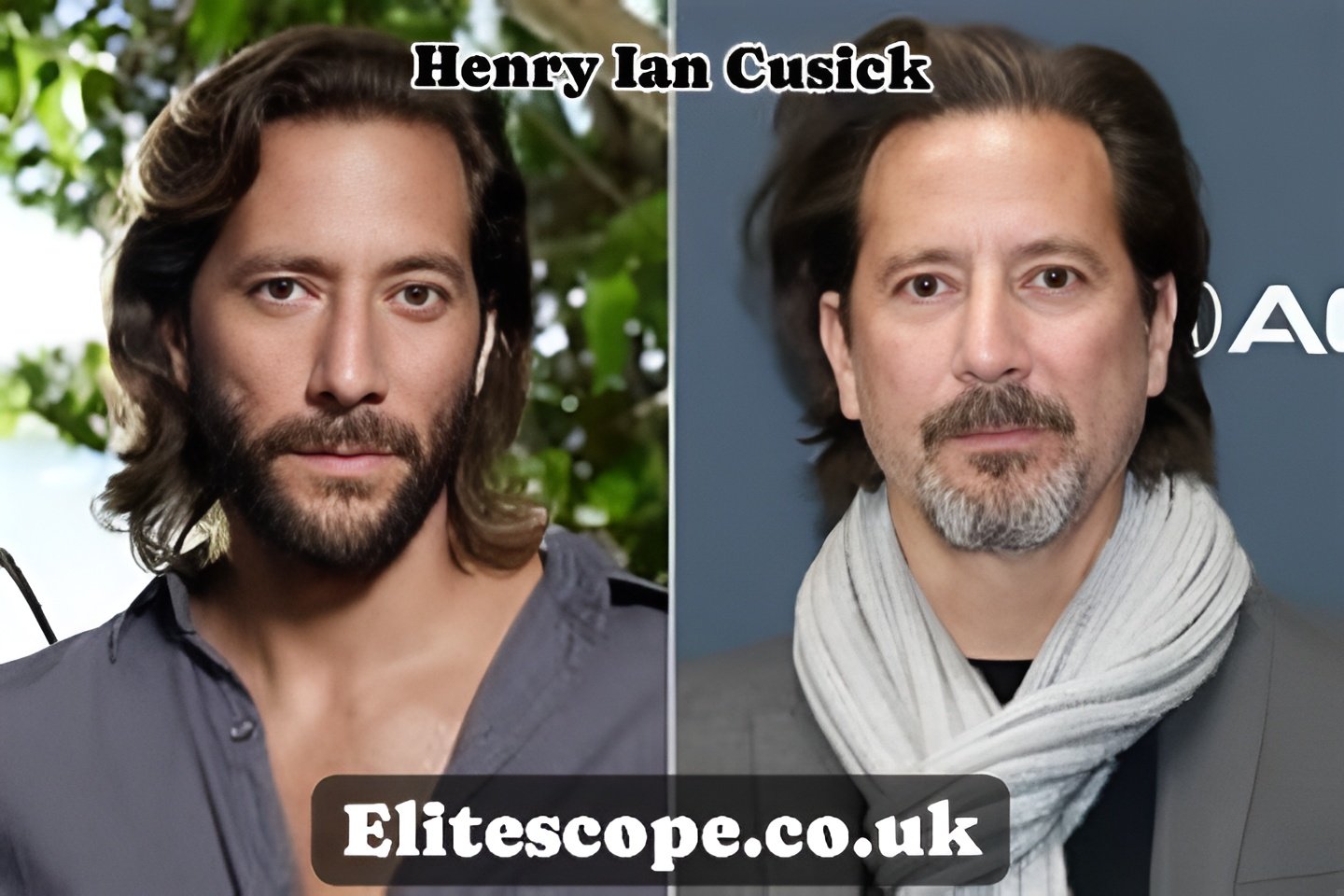
Peruvian-Scottish Actor | Emmy Nominee | Lost Star
Henry Ian Cusick is a Peruvian-Scottish actor born on April 17, 1967, in Trujillo, Peru. He is best recognized for his Emmy-nominated portrayal of Desmond Hume in the ABC drama Lost. Over his career spanning theatre, film, and television on both sides of the Atlantic, he has starred in major series including The 100, Scandal, MacGyver, and The Passage, earning widespread critical acclaim for his versatility and emotional depth.
Henry Ian Cusick is a multi-award-nominated actor whose career is a remarkable study in cultural versatility and dramatic range. Born in Peru to a Scottish father and Peruvian mother, he grew up across four countries — Peru, Spain, Trinidad and Tobago, and Scotland — before training at the Royal Scottish Academy of Music and Drama. His foundational years in classical theatre with the Royal Shakespeare Company and Citizens Theatre Glasgow gave him the technical discipline that would later define his screen performances. American audiences discovered him through Lost, where his portrayal of Desmond Hume became one of the show’s most beloved storylines. Since then, he has delivered commanding performances across several hit network series, cemented his identity as a dependable leading man, and even expanded into directing. Today, he lives in Hawai’i and remains an active performer and SAG-AFTRA board member.
Quick Biography Table
| Full Name | Henry Ian Cusick Chávez |
| Date of Birth | April 17, 1967 |
| Birthplace | Trujillo, Peru |
| Nationality | Peruvian-Scottish (Dual US & British Citizen) |
| Profession | Actor, Director, Producer, Writer |
| Training | Royal Scottish Academy of Music and Drama |
| Spouse | Annie Wood (married 1992) |
| Children | Three sons |
| Best Known For | Desmond Hume in Lost (ABC) |
| Awards | Emmy Nomination, Ian Charleson Award Commendation |
| Languages | English, Spanish (Fluent) |
| Current Residence | Kailua, Hawai’i, USA |
Introducing Who Is Henry Ian Cusick?
A Global Citizen From His Very First Breath
Henry Ian Cusick is one of those rare performers whose real life story reads as dramatically as any script he has ever been handed. Born on April 17, 1967, in the coastal Peruvian city of Trujillo, he was the product of a truly international union — a Peruvian mother named Esperanza Chávez and a Scottish father, Henry Joseph Cusick. Before he even reached school age, his family had already begun moving across continents, beginning a pattern of cultural exposure that would fundamentally shape his personality, his language skills, and ultimately his acting philosophy. Growing up between worlds is not easy, but for Cusick, it became the foundation of his extraordinary empathy as a performer.
From Trinidad to the Scottish Highlands
The Cusick family’s journey took them from Peru to Madrid, Spain, and then onward to the twin-island nation of Trinidad and Tobago, where young Henry spent roughly a decade of his formative years. He attended Presentation College in San Fernando, Trinidad, absorbing the warmth and rhythms of Caribbean life. At the age of fourteen, the family relocated again — this time to Newton Mearns, a suburb just outside Glasgow, Scotland. This final move proved pivotal: Scotland would become the place where Cusick first walked onto a stage, discovered his calling, and began building the craft that would take him all the way to Hollywood’s biggest television stages decades later.
The Making of a Classical Theatre Actor
Cusick enrolled at the Royal Scottish Academy of Music and Drama — now known as the Royal Conservatoire of Scotland — though his time there was cut short when he was asked to leave in his second year. Far from derailing him, this setback only pushed him harder. His first taste of real performance came as an understudy playing a polar bear in a Christmas pantomime at the Citizens’ Theatre in Glasgow. From that humble beginning, he rose quickly through the ranks of classical theatre, working with Scotland’s most prestigious companies. His natural charisma and dedication to craft earned him roles that most young actors could only dream about, setting the stage for everything that followed.
The Classical Theatre Years That Forged a Screen Legend
Performing Shakespeare and Beyond at the Citizens’ Theatre
The Citizens’ Theatre in Glasgow became Cusick’s true training ground after his departure from drama school. There he took on major classical roles including Dorian Gray in an adaptation of Oscar Wilde’s The Picture of Dorian Gray — opposite the esteemed Rupert Everett — as well as Hamlet in the Marowitz Hamlet and Horner in William Wycherley’s restoration comedy The Country Wife. These were not minor productions; they were critically watched, demanding interpretations of some of the most challenging characters in the Western dramatic canon. Playing alongside established actors like Everett at such an early stage of his career gave Cusick a professional baseline that few performers of his generation could match.
The Ian Charleson Award — A Mark of Theatrical Excellence
In 1994, Cusick delivered two standout stage performances that would earn him a special commendation at the prestigious Ian Charleson Awards in 1995 — an award given exclusively to actors under 30 for outstanding classical theatre performances. The first was the title role in Torquato Tasso at the Edinburgh International Festival, presented by the Royal Lyceum Theatre. The second was his portrayal of Creon in Oedipus Rex at the Citizens’ Theatre Glasgow. The Ian Charleson commendation was a significant stamp of approval from the British theatrical establishment, signaling that this young Peruvian-Scottish actor was not merely promising — he was already extraordinary.
Collaborating With the Royal Shakespeare Company and National Theatre
Cusick’s stage ambitions did not stop at Glasgow. Over the course of his theatre career, he worked with some of Britain’s most celebrated institutions, including the Royal Shakespeare Company, the Royal National Theatre, the Almeida Theatre in London, and the Liverpool Playhouse. Each engagement added layers of technique, discipline, and expressive range to his performance toolkit. Working within these companies meant working beside some of the finest directors and fellow actors in the English-speaking world. This rigorous classical background is precisely what allowed Cusick to bring such nuanced, layered performances to the television roles that made him famous — a depth that audiences recognized even when they couldn’t quite articulate why.
Breaking Into British Television and Early Screen Roles
Casualty, The Book Group, and Building a Screen Profile
While Cusick was steadily building his theatrical reputation, he was simultaneously making inroads into British television. He made his screen debut in a 1993 episode of the long-running Scottish detective drama Taggart, and from there accumulated a range of appearances across UK television. His most sustained early role was a nine-episode arc on the BBC medical drama Casualty — one of Britain’s most popular long-running series — where he demonstrated that his stage command translated effectively to the intimacy of the camera. He also appeared in a recurring capacity on The Book Group, a well-reviewed BBC comedy series, further expanding his range as an actor comfortable in both dramatic and lighter comic registers.
Portraying Jesus Christ in The Gospel of John
Perhaps the most significant early screen milestone in Cusick’s career was his starring role as Jesus Christ in the 2003 Canadian-British film The Visual Bible: The Gospel of John. The film was a direct, word-for-word dramatization of the Gospel of John from the Good News Bible, and Cusick took on the monumental challenge of portraying one of history’s most revered figures with sensitivity, gravity, and authenticity. The role demanded extraordinary physical and emotional commitment, and Cusick rose to the occasion. The film was distributed internationally and introduced him to a far wider audience than any of his British stage or television work had reached. It was, in many respects, the performance that put him on the radar of American producers.
A Chance Encounter That Changed Everything
The story of how Cusick landed his career-defining American role is one of those stranger-than-fiction tales that Hollywood loves to tell. While staying at the home of his friend, the acclaimed Scottish-American actor Brian Cox, Cusick happened to meet Cox’s neighbor: Carlton Cuse, the executive producer of the ABC series Lost. The two had a conversation, and a seed was planted. The Lost team had been searching for an actor with Scottish or Irish roots for a particular character, and Cusick fit the profile perfectly. It was a fortuitous collision of timing, talent, and geography that would propel Cusick from the stages of Glasgow and Edinburgh directly into the living rooms of tens of millions of American television viewers.
Lost: The Role That Made Henry Ian Cusick a Household Name
Desmond Hume — A Character Born for the Ages
When Henry Ian Cusick appeared in the second season of Lost in 2005 as Desmond Hume, he brought to the screen a character unlike anything the show had offered before. Desmond was a former soldier and monk who had been pushed by heartbreak to sail around the world, only to end up shipwrecked on a mysterious island and tasked with pushing a button every 108 minutes to prevent — supposedly — the end of the world. The role required Cusick to channel profound loneliness, romantic longing, philosophical doubt, and bursts of explosive action. He gave Desmond a Scottish accent so authentic and a emotional complexity so convincing that fans worldwide fell deeply in love with the character almost immediately.
Emmy Nomination and Saturn Award Recognition
Cusick’s performance in Lost earned him a Primetime Emmy Award nomination for Outstanding Guest Actor in a Drama Series, a remarkable achievement for a relative newcomer to American television. He was also nominated for two Golden Nymph Awards at the Monte-Carlo Television Festival for Outstanding Actor in a Drama Series in 2007 and 2009, and received a Saturn Award nomination for Best Supporting Actor in Television in 2009. These nominations were not mere industry courtesy — they reflected a genuine critical consensus that Cusick had delivered something special. What began as a guest arc in season two evolved into a regular cast position from seasons three through six, cementing Desmond Hume as one of the most beloved characters in Lost’s rich ensemble.
The Phrase That Defined a Generation of Television
Among Lost’s most iconic elements was Desmond Hume’s recurring phrase, ‘See you in another life, brotha’ — delivered in Cusick’s warm Scottish brogue. The line became a cultural touchstone, reproduced on merchandise, quoted across the internet, and embedded in the memories of an entire generation of television viewers. It spoke to themes of fate, love, loss, and the possibility of redemption — themes that resonated far beyond the boundaries of the show itself. Cusick’s ability to deliver such lines with absolute sincerity, without ever tipping into sentimentality, was a masterclass in restrained acting. His chemistry with co-star Sonya Walger, who played his love Penny, produced some of the show’s most emotionally devastating scenes.
Life After Lost: A Prolific and Varied American Career
Scandal, The 100, and MacGyver — A String of Major Roles
Following Lost’s conclusion in 2010, Cusick demonstrated that Desmond Hume was not a one-hit wonder but a launchpad for an impressive roster of American television roles. He joined the cast of Shonda Rhimes’s political thriller Scandal as Stephen Finch, appeared as a German intelligence officer in the thriller 24, and then secured a six-season series regular role as Marcus Kane in The CW’s post-apocalyptic drama The 100. Kane was a morally complex authority figure who evolved dramatically over the show’s run, allowing Cusick to showcase the kind of long-arc character work he had mastered in classical theatre. He subsequently starred as Russ Taylor on CBS’s MacGyver reboot for multiple seasons.
The Passage, Big Sky, and Recent Projects
Cusick’s television work continued with a starring role as Dr. Jonas Lear in Fox’s science-fiction thriller The Passage in 2019 — a show based on Justin Cronin’s bestselling novel about a government experiment that inadvertently creates vampire-like creatures. He followed this with a substantial recurring arc across 13 episodes of ABC’s thriller Big Sky as Avery McAllister, as well as recurring roles in NCIS: Hawai’i and 9-1-1: Lone Star. His most recent major screen credit was a guest appearance in Amazon’s Butterfly in 2025, demonstrating that nearly two decades after Lost, he remains a sought-after presence in American prestige television. His range — from political drama to sci-fi thriller to procedural — underscores his theatrical versatility.
Voice Acting and Directing Ambitions
Beyond his live-action work, Cusick has expanded his artistic footprint into voice acting and directing. He voices the beloved character of Peet the Sock Man in the animated Christian fantasy series The Wingfeather Saga, which premiered on the Angel Network in December 2022 to extraordinary response — 1.4 million views within the first 30 minutes. Season 4 of that series is currently in production. On the directing front, Cusick helmed two episodes of The 100: ‘The Other Side’ in Season Four and ‘The Warriors Will’ in Season Five, both written by Julie and Shawna Benson. Earlier, he had directed the short film dress, which won the Audience Award at the Hawaii International Film Festival for Best Short Film in 2013.
Personal Life, Values, and Life in Hawai’i
Family, Faith, and a Life Built on Roots
Henry Ian Cusick married Annie Wood in 1992, and the couple have built a long, stable life together that has grounded him throughout the upheavals of an international acting career. They have three sons. Cusick was raised Roman Catholic — a faith that has clearly informed some of his most meaningful professional choices, including his portrayal of Jesus Christ and his consistent interest in stories that explore moral complexity and redemption. His wife Annie is also professionally active; she served as curator of the JamBios Memory Gallery, a tech project that Cusick supported when he partnered with the start-up JamBios in 2017 to record over 200 memory-prompting questions for their digital biographer platform.
Hawai’i — A Home That Reflects His Global Soul
Today, Henry Ian Cusick lives in Kailua, on the windward coast of O’ahu, Hawai’i. It is a choice that feels entirely fitting for a man born in Peru, raised in Trinidad and Scotland, trained in Glasgow and Edinburgh, and who found his greatest fame in the American television landscape. Hawai’i is itself a cultural crossroads — Pacific, American, and Indigenous all at once — and Cusick has made it not just a home but a community. He serves as a SAG-AFTRA National Board member for Hawai’i, representing the interests of professional actors across the islands. He is fluent in both English and Spanish, holds dual US and British citizenship, and continues to accept fan mail and autograph requests through his Kailua address.
A Prankster, a Colleague, and a Constant Professional
Those who have worked with Cusick uniformly describe him not just as a talented actor but as a genuinely warm and lively presence on set. Colleagues from The 100 — including Christopher Larkin, Richard Harmon, and Ricky Whittle — have publicly named him the biggest prankster on the production. This quality, the ability to keep a set energized and its cast connected through humor and camaraderie, speaks to the human side of an actor who might otherwise seem defined entirely by the gravity of his most famous roles. It also underscores a central truth about Cusick: he has never become remote or inaccessible in the way that fame can sometimes make performers, remaining approachable, collaborative, and deeply appreciative of the craft he has dedicated his life to.
Conclusion: A Career Built on Craft, Character, and Courage
Henry Ian Cusick’s journey from a Christmas pantomime polar bear in Glasgow to an Emmy-nominated television icon is one of the most genuinely compelling stories in contemporary acting. His multicultural upbringing, rigorous classical training, and willingness to take on complex, morally layered characters have produced a career that is both commercially successful and artistically distinguished. He has never chased trends or played it safe — from Jesus Christ to a time-bending Scottish castaway to a post-apocalyptic politician to a vampire-pandemic scientist — and that adventurousness has kept him relevant across three decades. As he continues to act, direct, do voice work, and advocate for his profession in Hawai’i, the arc of his career remains very much in progress, and every indication suggests its finest chapters may still be ahead.
Frequently Asked Questions (FAQs)
Q1: Where was Henry Ian Cusick born?
He was born on April 17, 1967, in Trujillo, Peru, to a Scottish father and a Peruvian mother. He grew up across multiple countries including Spain, Trinidad and Tobago, and Scotland.
Q2: What is Henry Ian Cusick most famous for?
He is most famous for playing Desmond Hume in the ABC drama Lost (2004–2010), a role for which he received a Primetime Emmy Award nomination and two Golden Nymph Award nominations.
Q3: Did Henry Ian Cusick win an Emmy Award?
He was nominated for a Primetime Emmy Award for Outstanding Guest Actor in a Drama Series for his work in Lost, but did not win. He did win the Audience Award at the Hawaii International Film Festival for his short film dress in 2013.
Q4: What other TV shows has he appeared in?
Beyond Lost, he has starred in The 100 (6 seasons), Scandal, MacGyver, The Passage, Big Sky, NCIS: Hawai’i, 9-1-1: Lone Star, 24, Fringe, and Body of Proof, among others.
Q5: Is Henry Ian Cusick Scottish or Peruvian?
He is both — his father is Scottish with Irish ancestry, and his mother is Peruvian. He holds dual US and British citizenship and is fluent in English and Spanish.
Q6: Has Henry Ian Cusick directed any projects?
Yes. He directed two episodes of The 100 — ‘The Other Side’ (Season 4) and ‘The Warriors Will’ (Season 5) — and previously directed the short film dress, which won an audience award at the Hawaii International Film Festival.
Q7: What is Henry Ian Cusick doing now in 2025–2026?
He recently guest starred in Amazon’s Butterfly (2025), continues his voice role as Peet the Sock Man in The Wingfeather Saga (Season 4 in production), serves as a SAG-AFTRA National Board member for Hawai’i, and remains active in the American television industry.
